
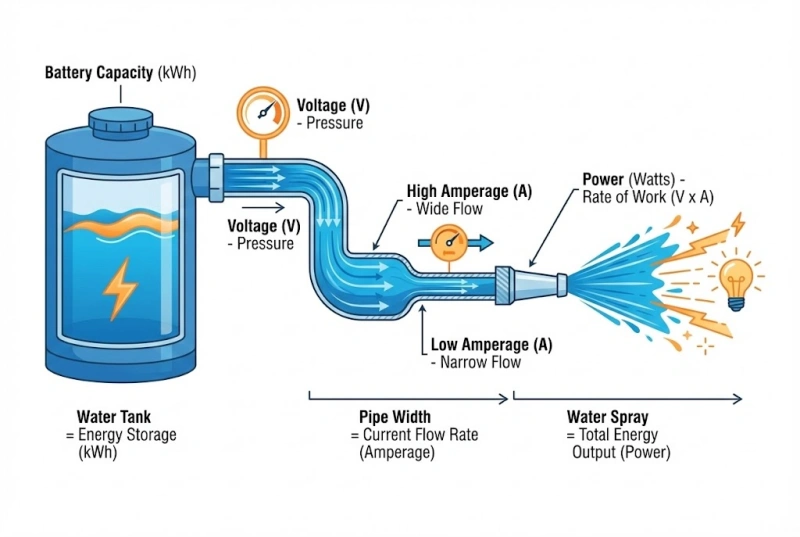
ESS 101: Volts, Amps, & Watts Explained for Commercial Buyers (2026 Guide)
Master energy storage fundamentals. We explain Volts, Amps, and Watts using the water pipe analogy to help B2B buyers optimize ROI and safety in 2026.
ESS Fundamentals: The “Water Pipe” Analogy for Volts, Amps, and Watts
As we navigate the energy landscape of 2026, the global shift toward decentralized power is no longer just a policy goal—it is a commercial imperative. With the IEA World Energy Outlook 2025 projecting renewable capacity to triple, B2B stakeholders (distributors, installers, and project integrators) face a critical challenge: technical literacy.
In my 20 years designing Energy Storage Systems (ESS), I have seen million-dollar projects stalled not by capital, but by a misunderstanding of basic physics. Confusing “Power” (kW) with “Capacity” (kWh) can lead to disastrous ROI calculations and safety compliance failures under standards like UL9540A. To demystify the electrochemistry, we use the industry-standard “Garden Hose” analogy. This isn’t just theory; it is the framework for sizing every commercial battery system on the market today.
1. Volts (V): The Electrical “Water Pressure”
Imagine your ESS is a water tank. Voltage is the water pressure. It is the electromotive force that pushes electrons through the wire.
In the commercial and industrial (C&I) sector, we are seeing a massive migration from low-voltage (48V) to High Voltage (HV) systems (400V–1500V). Why? Just as high water pressure allows you to move water further without losing momentum, high voltage allows electricity to travel with less resistance. This is crucial for efficiency. A 1000V DC bus architecture reduces conversion losses, directly improving your system’s Round-Trip Efficiency (RTE).
2. Amps (A): The Flow Volume (and Heat Risk)
Amperage (Amps) represents the volume of water flowing through the hose per second. In our analogy, the “thickness” of the hose (wire gauge) must be wide enough to handle this flow.
This is where B2B buyers must pay attention to Safety & Cost.
If you try to force a high volume of water (High Amps) through a narrow straw (thin wire), the friction creates heat. In an ESS, this heat ($$I^2R$$ loss) is the enemy. It degrades LFP (Lithium Iron Phosphate) cells and can trigger thermal runaway protections. To handle high Amps, you need thick, expensive copper cabling. This is why we prefer High Voltage systems—they deliver the same power with fewer Amps, allowing for thinner cables and lower installation costs.
3. Watts (W): The Real-Time Power Output
The Watt is what actually does the work. It is the total amount of water coming out of the hose at any given moment. It is the product of pressure (Volts) and flow (Amps):
For an installer, the Wattage rating on an inverter or appliance nameplate is the most critical number. It dictates the “Peak Load.” If a factory has machinery that requires 50kW to start, your ESS inverter must be able to output 50,000 Watts instantaneously, regardless of how much energy is stored in the battery.
4. Watt-Hours (Wh): The Bucket Size (Capacity)
While Watts represent the speed of the water, Watt-hours (Wh) or Kilowatt-hours (kWh) represent the size of the bucket. This is your energy reservoir.
According to BloombergNEF trends for 2026, the market is shifting toward “Long Duration” storage (4-hour to 8-hour systems). This means buyers are prioritizing massive kWh (Capacity) over just raw kW (Power) to handle grid arbitrage and backup during extended outages.
Technical Specs vs. Business Reality
| Metric | Water Analogy | Why It Matters for B2B Buyers | Key Risk Factor |
|---|---|---|---|
| Voltage (V) | Water Pressure | Determines system efficiency and inverter compatibility. Higher V = Lower install cost. | Dielectric breakdown if mismatched. |
| Amperage (A) | Flow Volume | Dictates cable thickness (Copper cost) and thermal management requirements. | Overheating & UL9540A failure. |
| Watts (W) | Spray Output | The “Muscle” of the system. Decides how many appliances can run simultaneously. | Inverter overload shutdowns. |
| Watt-hours (Wh) | Bucket Size | The “Gas Tank.” Decides how long the business stays powered during a blackout. | Depth of Discharge (DOD) limits. |
Technical FAQ for Project Integrators
Generally, no. Adding battery modules usually increases Energy (kWh), not Power (kW). The Power limit is typically dictated by the Inverter’s capacity and the BMS current limit. To get more Watts, you usually need a larger inverter, not just more cells.
ROI. By doubling the voltage, we can halve the current (Amps) required for the same power output ($$P=VI$$). Lower Amps means 50% less heat loss ($$I^2R$$) and significantly thinner, cheaper cabling. This reduces Balance of System (BOS) costs by up to 15%.
The C-rate is the bridge between Power and Energy. A 10kWh battery discharging at 1C provides 10kW of power for 1 hour. Discharging at 0.5C, it provides 5kW for 2 hours. Most LFP stationary storage is optimized for 0.5C to prolong cell life and ensure safety.
High Amperage generates heat. If a system is consistently pushed to its maximum Amperage rating, the internal temperature of the cells rises, accelerating chemical degradation (SEI layer growth). This leads to premature capacity loss, potentially voiding performance warranties.
In cold weather, the internal resistance of the battery increases (the “pipe” gets narrower). The BMS will throttle the Amperage to protect the cells, effectively reducing your available Wattage. Always check the temperature de-rating curve in the datasheet.
