
What’s BMS?
Note: This article is summarized from our team's daily technical support experience. We strive for accuracy and welcome your feedback or corrections.
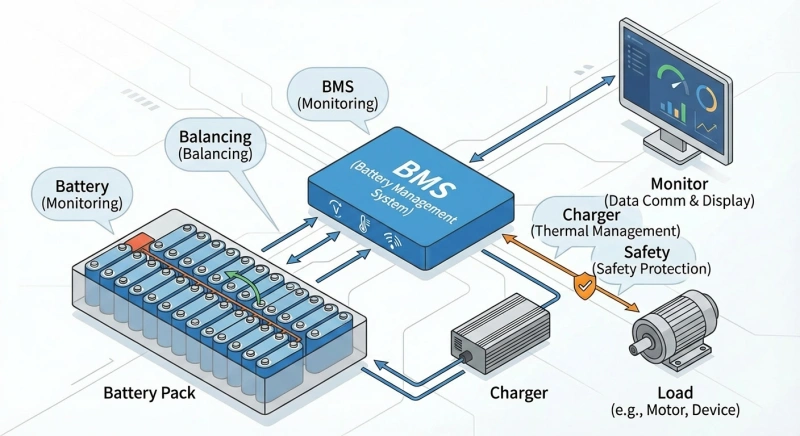
In a portable power station, the BMS (Battery Management System) is often described as the “brain” of the device.
Since these stations use high-density lithium batteries (like LiFePO4 or NMC), they require constant electronic supervision to prevent damage, ensure safety, and maximize the lifespan of the unit.
Without a BMS, a portable power station would be prone to overheating, permanent capacity loss, or even fire.
Core Functions of a BMS
The BMS performs four critical roles simultaneously:
1. Safety Protection (The Safeguard)
The BMS monitors the battery’s “Safe Operating Area” (SOA) and will instantly shut down the power flow if it detects:4
-
Overcharge/Over-discharge: Prevents the battery from being pushed to dangerously high or low voltages, which causes permanent chemical damage.5
-
Short Circuit Protection: Detects sudden electrical faults and cuts power in milliseconds to prevent explosions.6
-
Overcurrent Protection: Stops the station from drawing more power than the battery cells can safely handle (e.g., trying to run a heavy appliance like a heater on a small station).7
2. Thermal Management
Lithium batteries are extremely sensitive to heat and cold.8
-
Overheat Protection: If the internal temperature rises too high during heavy use or fast charging, the BMS will throttle the power or shut the unit down to prevent “thermal runaway.”9
-
Cold-Weather Protection: Many systems will prevent charging in freezing temperatures (below 0°C), as charging while frozen can permanently ruin lithium cells.10
3. Cell Balancing
A power station isn’t just one giant battery; it is a “pack” made of dozens of small cells.11
-
The Issue: Over time, some cells charge faster than others.12 If one cell hits 100% while others are at 90%, the “full” cell would overcharge if the charger didn’t stop.
-
The Solution: The BMS “balances” the cells by bleeding off excess energy from the full ones so the weaker ones can catch up.13 This ensures you can use the 100% advertised capacity of the unit.
4. Data & State Estimation
The BMS calculates the “invisible” metrics that you see on your power station’s LCD screen:
-
SoC (State of Charge): The percentage of battery remaining.14
-
SoH (State of Health): How much the battery has degraded over the years.15
-
Time Remaining: Estimating how many hours the battery will last based on the current wattage being pulled.
BMS Components
To do its job, a BMS uses several specialized parts:16
-
Microcontroller: The processor that runs the logic and safety algorithms.17
-
Voltage/Current/Temperature Sensors: Constant “eyes” on every part of the battery pack.18
-
MOSFETs (Switches): These act as the physical gates that slam shut to cut power if a fault is detected.
Summary Table
| Feature | Why it matters |
| Overvoltage Protection | Prevents fires during charging. |
| Low-Voltage Cutoff | Prevents the battery from “dying” and never being able to recharge. |
| Cell Balancing | Extends the life of the station (e.g., getting 3000+ cycles). |
| Smart Monitoring | Gives you the accurate “85%” or “2 hours remaining” readout on your screen. |
Are you looking at a specific brand of power station? I can help you check if it uses a more advanced BMS (like those found in LiFePO4-based units) versus standard lithium-ion ones.
For a deeper dive into how these systems actually look and function inside a battery pack, you can watch this detailed explanation of BMS basics for LiFePO4 batteries.
This video is helpful because it uses LiFePO4 batteries as a practical example, which is the most common and safest battery type used in modern portable power stations.
