
Navigating the Nigeria Portable Power Market in 2026: Demand Drivers and Opportunities
“A deep dive into the growing demand for portable energy in Nigeria. Analyze market drivers, infrastructure challenges, and why lithium backup power is the future of energy resilience in the region.”
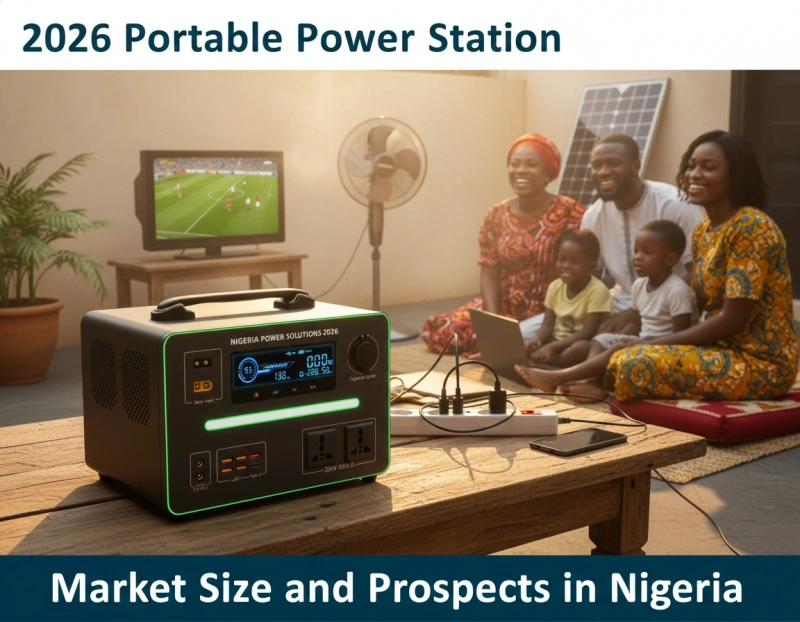
2026 Portable Power Station – Market Size and Prospects in Nigeria
In 2026, the Nigeria Portable Power Station (PPS) market has transitioned from a niche luxury to a critical survival commodity. Unlike Western markets where PPS units are used for “leisure and camping,” in Nigeria, they are the primary solution for the country’s chronic energy deficit.
Here is a deep dive into the market capacity and outlook for 2026:
1. Market Context: The “Great Fuel Transition”
Nigeria, with a population of over 220 million, faces a permanent electricity crisis.
-
The Death of Subsidies: By 2026, the removal of petrol and diesel subsidies (started in 2023-2024) has made running traditional small “I-pass-my-neighbor” gasoline generators prohibitively expensive for the average family.
-
The Grid Reality: National grid collapses remain frequent. This has forced over 17 million SMEs and tens of millions of households to seek independent, cost-effective power alternatives.
2. Market Capacity Estimates (2026)
-
Addressable Market: Approximately 40 to 50 million households and 17+ million MSMEs (Micro, Small, and Medium Enterprises).
-
Market Valuation: The combined market for PPS and small-scale Home Energy Storage Systems (HESS) in Nigeria is projected to exceed $600M – $850M USD by the end of 2026.
-
Core Segments: The strongest demand lies in the 500Wh to 2000Wh capacity range, capable of powering fans, laptops, TVs, and Wi-Fi routers for 4–8 hours.
3. Key Market Drivers
-
The “Solar + Storage” Synergy: In Nigeria, a PPS is rarely sold alone. It is almost always bundled with 100W–400W solar panels. Since grid charging is unreliable, solar is the only way to ensure the unit stays charged.
-
Remote Work & The Gig Economy: Nigeria has a massive youth population working in tech, creative arts, and remote freelance roles. For them, a PPS is a professional necessity to maintain 24/7 uptime.
-
Business Transformation: Small businesses like barbershops, pharmacies, and grocery stores are replacing noisy, smoky diesel generators with PPS units to save on fuel and create a better customer environment.
4. 2026 Market Characteristics & Pain Points
| Feature | Market Requirement |
| Battery Chemistry | LiFePO4 is now the absolute standard due to its high heat tolerance and 10-year lifespan. |
| Price Sensitivity | Extremely high. The “sweet spot” for volume sales is between $250 and $600 USD. |
| Financing (PAYGO) | Pay-As-You-Go and monthly installment models are the primary drivers of adoption for the lower-middle class. |
| Durability | Products must be dust-resistant and have high-quality cooling fans to survive the Nigerian climate. |
5. Competitive Landscape
-
The Dominance of “Tech-Savvy” Brands: Brands like EcoFlow, Bluetti, and Oraimo (the sister brand of TECNO mobile, which has a massive local footprint) are leading the market.
-
After-Sales Crisis: The biggest barrier to entry is trust. Consumers are wary of “fake” capacities. Brands that establish physical service centers in Lagos, Abuja, and Kano are winning the most market share.
6. Investment Outlook: 2026 and Beyond
Rating: Strategic Growth (High Demand / High Complexity)
Nigeria is no longer a “potential” market; it is an active displacement market. The PPS is actively replacing the millions of small fossil-fuel generators currently in use.
Strategic Recommendations for Entrants:
-
Local Partnerships: Partner with existing fintech or mobile distributors (like Transsion/Oraimo) to handle the “last-mile” delivery and payments.
-
Focus on “Power-to-Value”: Marketing should focus on “Fuel Savings Per Year” rather than just technical specs. Show the user how the machine pays for itself in 12 months.
-
Tropicalization: Ensure units are rated for high-ambient temperatures (35°C – 45°C) to prevent thermal shutdown.
Content in This Series

Blackout Means Shut Down? How Retailers in Central Asia, the Middle East, and Southeast Asia Safeguard Their POS Systems

