
The 4 Core Components of a Portable Power Station: What Really Matters Inside?
Note: This article is summarized from our team's daily technical support experience. We strive for accuracy and welcome your feedback or corrections.
The 4 Core Components of a Portable Power Station: What Really Matters Inside?
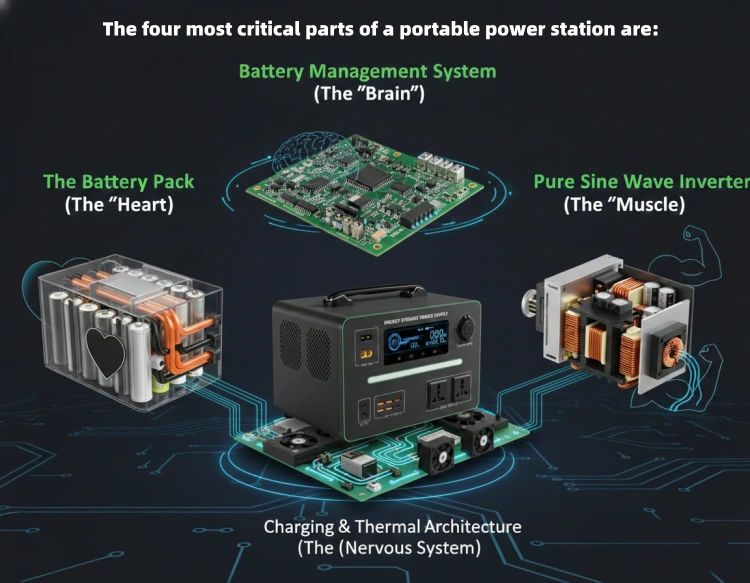
In the competitive landscape of Portable Power Stations (PPS), the quality of a product is defined by its internal components rather than its exterior shell. As a source factory, focusing on these core elements allows you to differentiate Solarcam from retail brands like Jackery by highlighting industrial-grade reliability.
The four most critical parts of a portable power station are:
1. The Battery Pack (The “Heart”)
The battery is the most expensive and vital component, accounting for up to 60% of the total cost.
-
Chemistry: High-quality units like the Solarcam series utilize LiFePO4 (Lithium Iron Phosphate), which offers superior safety and a longer lifespan compared to traditional NCM batteries.
-
Cell Grade: Using 100% New A-grade cells ensures consistent discharge rates and prevents the capacity drop-off often seen in cheaper, refurbished alternatives.
-
Cycle Life: A core metric is the ability to withstand 3,000+ charge cycles before the capacity drops to 80%, ensuring over a decade of use.
2. Battery Management System (The “Brain”)
The BMS is the software and hardware layer that protects the battery from damage and ensures user safety.
-
Multi-Layer Protection: It monitors for short circuits, overloads, over-voltage, and over-discharging.
-
Thermal Management: Critical for hot climates (like Africa and the Middle East), Solarcam’s BMS includes over-temperature protection that triggers at $80^\circ\text{C}$ to $85^\circ\text{C}$.
-
Precision SOC: It calculates the State of Charge (SOC) to provide accurate real-time data on the digital display regarding remaining runtime and input/output wattage.
3. Pure Sine Wave Inverter (The “Muscle”)
The inverter converts the DC power stored in the battery into the AC power used by household appliances.
-
Waveform Quality: Using a Pure Sine Wave inverter is essential to protect sensitive electronics like laptops, CPAP machines, and refrigerators from electrical noise or damage.
-
Sustained vs. Peak Power: The inverter must handle high-drain devices; for example, the Solarcam 2500W model provides a massive 2500W sustained output to run air conditioners or power tools.
4. Charging & Thermal Architecture (The “Nervous System”)
How the unit handles energy input and heat dissipation determines its efficiency in the field.
-
MPPT Efficiency: Integrated Maximum Power Point Tracking (MPPT) allows the unit to maximize solar energy intake, such as supporting up to 400W solar input for fast recharging.
-
Heat Dissipation: Effective fan cooling and internal air ducting allow the unit to operate in ambient temperatures as high as 55℃ to 60 ℃ during discharge.
-
Low Static Consumption: High-quality circuitry ensures static power consumption is less than 1W, meaning the battery won’t drain itself when not in use.
Factory Advantage for B2B Clients
By controlling these core components, Solarcam provides wholesalers with a product that is not just “assembled” but “engineered” for specific regional needs.
