
PET VS ETFE VS PV glass solar cell
Note: This article is summarized from our team's daily technical support experience. We strive for accuracy and welcome your feedback or corrections.
PET VS ETFE VS PV glass solar cell
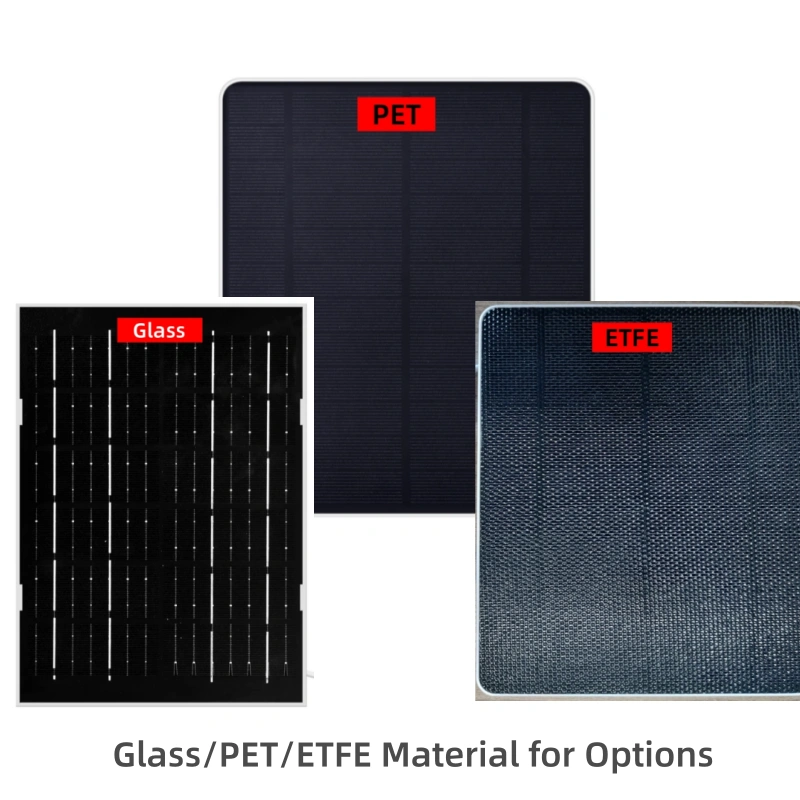
Here is a comprehensive comparison between PET, ETFE, and PV Glass—the three most common protective layers used in solar panels today.
1. Overview Table
| Feature | PET (Budget) | ETFE (Professional) | PV Glass (Standard) |
| Durability | Low (Yellows/Cracks) | High (Tough & Rugged) | Highest (Tempered) |
| Lifespan | 1 – 3 Years | 10 – 15 Years | 25+ Years |
| Weight | Very Light | Light | Heavy |
| Efficiency | ~15-18% | ~19-22% | 20-23% |
| UV Resistance | Poor (Degrades) | Excellent | Excellent |
| Maintenance | Manual Cleaning | Self-cleaning | Periodic Cleaning |
| Cost | $ (Cheapest) | $$$(Expensive) | $$ (Best Value) |
2. Deep Dive Comparison
PET (Polyethylene Terephthalate)
PET is essentially a thin plastic film (like a soda bottle).
-
Pros: It is the most affordable option. It is extremely thin and flexible, making it popular for “ultra-light” camping kits or solar backpacks.
-
Cons: It has poor UV stability. Over time, the sun’s rays cause the plastic to “atomize” and turn yellow, which blocks sunlight and kills the panel’s output. It also scratches easily and is prone to delamination (peeling apart).
-
Verdict: Best for occasional/temporary use where price is the only concern.
ETFE (Ethylene Tetrafluoroethylene)
ETFE is a high-strength, fluorine-based polymer often called “soft glass.”
-
Pros: It is a “stadium-grade” material (used on the Eden Project greenhouses).
It allows more light to pass through (95%) than PET. It is non-stick and self-cleaning; rain washes away dirt easily. It doesn’t yellow or crack even after a decade in harsh sun or salt spray.
-
Cons: It is significantly more expensive than PET. While flexible, it is still a polymer and can be scratched by very sharp objects compared to glass.
-
Verdict: The gold standard for portable power stations, RVs, and Marine/Boats.
PV Glass (Tempered Glass)
This is the traditional “rigid” solar panel found on house roofs.
-
Pros: Glass is the ultimate barrier against the elements. It provides the best protection for the fragile solar cells inside, preventing the “micro-cracks” that often kill flexible panels. It offers the best thermal management (airflow behind the frame).
-
Cons: It is heavy and breakable. It doesn’t bend, so it can’t follow the curve of a van or boat. It’s difficult to transport for “on-the-go” activities like hiking.
-
Verdict: Best for fixed installations where weight doesn’t matter and you want a 25-year investment.
3. Layer Construction Comparison
The difference isn’t just the top sheet; it’s the entire “sandwich” that protects the cells.
-
PET Stack: PET Film →EVA→Cell →EVA→Plastic Backsheet (Lowest protection).
-
ETFE Stack: ETFE Film →POE/EVA →Cell→POE/EVA →Fiberglass or Aluminum Backing (Reinforced for bending).
-
PV Glass Stack: Tempered Glass→EVA → Cell→EVA →Rigid Backsheet → Aluminum Frame (Armor-plated).
Which should you buy?
-
For a portable power station (Portable/Foldable): Get ETFE. The long lifespan and self-cleaning surface make it worth the extra money.
-
For a permanent roof/cabin setup: Get PV Glass. It is cheaper per watt and will last twice as long as anything else.
-
For a budget “emergency only” bag: PET is acceptable since it won’t spend much time in the sun.
We supply glass,PET and ETFE solar panel like from small 2W to large 200W,What kind of materail solar panel you looking for?
Contact us: [email protected]
