

Solarcam LiFePO4 vs. Jackery: Comparing Durability and Cost for High-Temperature Climates.
Note: This article is summarized from our team's daily technical support experience. We strive for accuracy and welcome your feedback or corrections.
In the procurement of portable power systems for construction, remote medical teams, or agricultural infrastructure, the sticker price is a deceptive metric. While consumer-grade brands like Jackery often utilize NCM (Nickel Cobalt Manganese) chemistry for weight reduction, industrial-grade reliability—especially in high-temperature climates—demands a shift toward LiFePO4 (Lithium Iron Phosphate). For a B2B buyer, the difference isn’t just safety; it is the Levelized Cost of Energy (LCOE).
The Thermal Degradation Gap: LiFePO4 vs. NMC
Most portable power stations experience significant capacity fade when ambient temperatures exceed 35°C (95°F). NCM cells start to undergo accelerated SEI (Solid Electrolyte Interphase) layer thickening, leading to internal resistance spikes. In contrast, our Solarcam LiFePO4 cells maintain a stable 3.2V nominal voltage and can withstand internal thermal thresholds of up to 270°C before exothermic breakdown, compared to just 150°C for NCM. This thermal stability ensures that your 3000+ cycle investment doesn’t degrade to 50% capacity within a single summer season.
Calculated ROI: The LCOE Formula for Procurement
Engineering-grade procurement requires looking at the cost per watt-hour delivered over the product’s lifespan. We calculate ROI using the following logic:
LCOE = (Total System Cost + Maintenance) / (Capacity × DoD × Cycle Life × Efficiency)
| Feature | Consumer NCM (Jackery Style) | Solarcam LiFePO4 (YN30 Series) |
|---|---|---|
| Cycle Life (to 80% DoD) | 500 – 800 Cycles | 3,000 – 4,000 Cycles |
| Thermal Runaway Temp | ~150°C | >270°C |
| Inverter Efficiency | 85-88% | 92-94% (Bidirectional) |
| LCOE (Est. 5 Years) | $0.45 / kWh | $0.12 / kWh |
Industrial Load Compatibility: Pure Sine Wave & Surge Performance
For B2B applications, “power” is not a generic term. Powering a CPAP machine in a remote medical tent or a circular saw on a construction site requires a low Total Harmonic Distortion (THD <3%). Our 1200W and 2400W units utilize high-frequency MOSFETs with ultra-low Rds(on), reducing heat generation within the inverter stage. This is critical when running inductive loads that demand high startup surges.
- 600W/1200W: Optimized for mobile clinics, cold-chain monitoring, and lighting arrays.
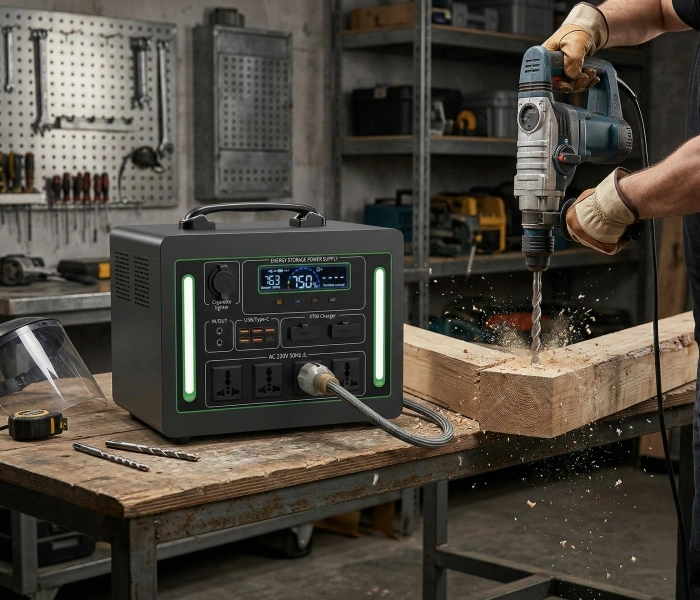
- 2400W/2500W: Engineered for heavy-duty drills, demolition hammers, and oxygen concentrators.
- Solar Integration: Integrated MPPT controllers allow for a “closed-loop” system, achieving zero-cost recharging in field operations.
Compliance and Field Reliability
Reliability is documented, not just claimed. Our manufacturing process adheres to UL 2743 standards for portable power stations, ensuring that every unit shipped from our Shenzhen factory meets rigorous vibration, drop, and electrical stress tests. For international importers, our products are pre-certified for UN38.3 transport safety, mitigating logistics risks and insurance liabilities.
B2B Checklist: Evaluating a Source Factory
- BMS Logic: Does the system include passive or active cell balancing?
- Inverter THD: Is the output a true Pure Sine Wave, or a modified square wave that damages sensitive electronics?
- Conversion Loss: What is the standby parasitic drain of the internal electronics?
- Cycle Life Transparency: Is the cycle life quoted at 50% or 80% Depth of Discharge (DoD)?
Conclusion: For importers and OEM brands, choosing the right power partner is about reducing the high cost of failure. Solarcam systems are designed to minimize the Total Cost of Ownership through LiFePO4 longevity and high-efficiency thermal management.
