

Solarcam vs. Jackery: Choosing the Right Solar Storage for Developing Economies.
Note: This article is summarized from our team's daily technical support experience. We strive for accuracy and welcome your feedback or corrections.
In developing economies, the cost of power is not measured by the initial purchase price, but by the Levelized Cost of Energy (LCOE) over the equipment’s lifespan. While consumer-grade brands like Jackery excel in lightweight portability for weekend camping, industrial procurement for construction sites, remote medical clinics, and cold-chain logistics requires a different engineering philosophy. At Yanni (Shenzhen) Technology, we design for the “Total Cost of Ownership.”
The Fallacy of Low-Cost Lead-Acid and NCM Batteries
Many B2B buyers fall into the trap of comparing capacity (Wh) without accounting for Depth of Discharge (DOD) and cycle degradation. A standard NCM (Nickel Cobalt Manganese) battery typically offers 500–800 cycles before hitting 80% capacity. In a high-demand environment—such as a remote farm or a field hospital—where the unit is cycled daily, an NCM unit fails in less than two years.
By contrast, our Professional 2500W LiFePO4 Power Station utilizes automotive-grade LiFePO4 cells capable of 3,000+ deep cycles. This shifts the procurement perspective from an expense to a 10-year asset.
Technical Breakdown: Efficiency vs. Heat Dissipation
Engineering a high-ROI power station involves managing the conversion loss. Every percentage of efficiency lost in the inverter stage is heat that degrades the battery cells.
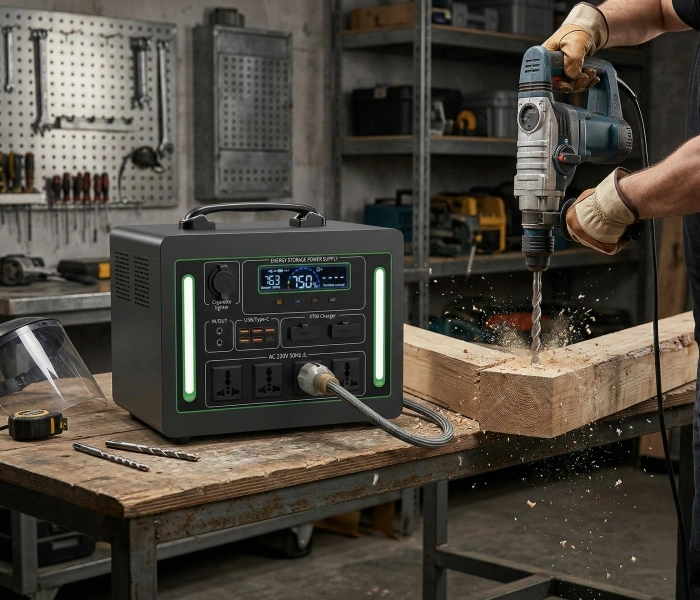
- Pure Sine Wave Inverters: Our bidirectional inverters maintain a Total Harmonic Distortion (THD) of <3%. This is critical for medical CPAP machines and sensitive drill controllers which can overheat or fail when powered by modified sine waves.
- Thermal Management: Industrial units require MOSFETs with low Rds(on) to minimize internal resistance. This allows our 1200W and 2400W units to run at full load without thermal throttling, a common failure point in consumer “plastic-casing” competitors.
ROI Comparison: Yanni Solarcam vs. Standard Consumer Units
The following table illustrates the economic reality for a mobile clinic or construction firm operating over a 5-year period.
| Metric | Consumer NCM (Jackery-style) | Yanni Solarcam (LiFePO4) |
|---|---|---|
| Cycle Life (to 80% Capacity) | 500 – 800 Cycles | 3,000+ Cycles |
| Operating Temperature Range | Limited (Thermal Shutdown likely) | Industrial Grade (-10°C to 45°C) |
| Estimated Replacement Rate | Every 18-24 Months | 8-10 Years |
| LCOE (Cost per kWh) | High (Due to rapid replacement) | Low (High initial ROI) |
Solar Integration: Achieving Energy Independence
In regions with unstable grids, the power station must function as part of a closed-loop solar system. Our units feature integrated MPPT (Maximum Power Point Tracking) controllers with a 98% tracking efficiency. By pairing our High-ROI 600W Portable Power Station with ETFE-laminated solar kits, remote projects can achieve 24/7 autonomy without the noise, emissions, or fuel logistics of diesel generators.
The Procurement Checklist for Industrial Buyers
Before placing a bulk OEM order, engineers should verify the following technical compliance standards:
- Safety Standards: Ensure the unit meets UL 2743 for portable power systems, specifically focusing on overcharge and short-circuit protection logic.
- BMS Architecture: Does the Battery Management System offer individual cell balancing and low-temperature charging cutoff? (Crucial for LiFePO4 longevity).
- Peak Surge Capacity: Can the 1200W unit handle the 3x inrush current required to start a motorized drill or refrigerator compressor?
Conclusion for Importers and Distributors
For developing economies, reliability is the only feature that matters. A power station that fails during a medical procedure or in the middle of a remote construction schedule is a liability, regardless of its initial price. Yanni Technology provides the engineering transparency and manufacturing scale to ensure your off-grid projects remain operational and profitable.
Contact our engineering team to review full specifications or request a factory audit for your next bulk project.
