
PET Solar Panel Advantage and Disadvantage
Note: This article is summarized from our team's daily technical support experience. We strive for accuracy and welcome your feedback or corrections.
PET Solar Panel Advantage and Disadvantage
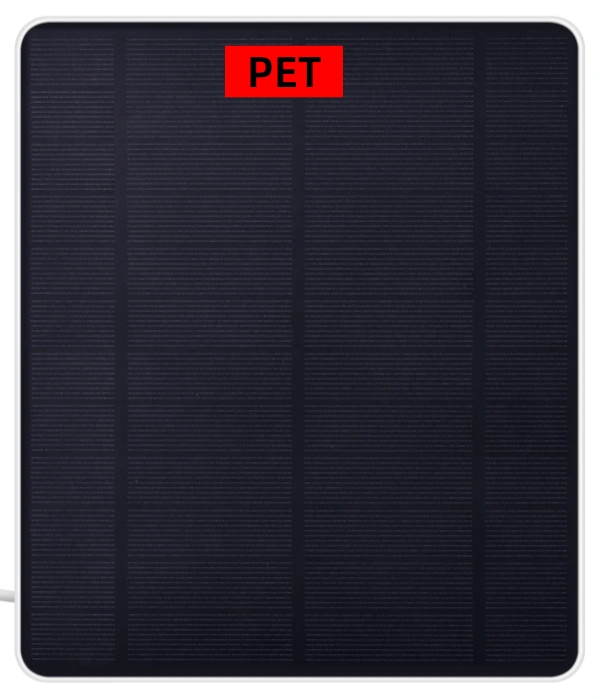
PET (Polyethylene Terephthalate) is the “budget-friendly” alternative to ETFE.
It is a polyester-based plastic—essentially the same material used to make soda bottles. In the solar industry, it is widely used for low-cost, portable, or small-scale solar panels.
While it gets the job done for occasional use, it has several technical limitations compared to the more rugged ETFE.
1. Advantages (Pros)
-
Affordability: This is the primary reason PET exists in the market. PET panels are usually 25% to 40% cheaper than ETFE panels.
-
Lightweight: PET is extremely thin and light, making it ideal for very small gadgets like solar backpacks, solar toys, or small power bank chargers.
-
Flexibility: Because it is a softer plastic, PET panels can be made very thin and pliable, allowing them to bend easily over curved surfaces (like the top of a tent).
-
High Initial Clarity: When brand new, high-quality PET has good light transmittance (around 85–90%), which is sufficient for basic charging needs.
2. Disadvantages (Cons)
-
UV Degradation (Yellowing): Unlike ETFE, PET is not naturally UV-stable. Over time, constant exposure to the sun causes a chemical reaction that makes the plastic turn yellow and opaque. This significantly reduces the amount of light reaching the solar cells.
-
Short Lifespan: While ETFE panels can last 10 years, PET panels typically have a functional lifespan of only 1 to 3 years if used frequently outdoors.
-
Delamination & Cracking: Heat and humidity cause PET to become brittle. The layers of the panel may start to “peel apart” (delaminate), allowing moisture to enter and corrode the solar cells.
-
Low Heat Resistance: PET starts to soften or deform at much lower temperatures than ETFE. In high-heat environments (like a desert or a dark roof), the plastic can warp or bubble.
-
Maintenance Heavy: PET is a “sticky” plastic compared to ETFE. Dust, pollen, and grime bond to the surface easily, and it does not have the “self-cleaning” properties of ETFE. You will need to wipe it down manually much more often.
3. Application Scenarios
-
Entry-Level Consumer Electronics: Small panels for charging phones, tablets, or power banks that are only used occasionally (e.g., a weekend hiking trip).
-
Disposable/Short-Term Projects: Temporary power for outdoor events or school science projects where long-term durability isn’t required.
-
Indoor/Window Use: Since UV exposure is lower indoors (most windows block some UV), PET panels can last longer when used behind glass.
-
Budget-Constrained Kits: Low-cost “starter” solar kits for people who want to experiment with solar power without a large upfront investment.
Summary Comparison: PET vs. ETFE
| Feature | PET (Budget) | ETFE (Premium) |
| Durability | Low (Yellows/Cracks) | High (UV-stable/Non-aging) |
| Surface Texture | Usually Smooth & Shiny | Often “Honeycomb” (Anti-glare) |
| Transmittance | ~85% – 90% | Up to 95% |
| Cleaning | Needs scrubbing | Self-cleaning (Rain washes it) |
| Best For | Occasional/Light use | Professional/Marine/RV use |
Are you looking for a panel for a specific “survival” kit or a permanent installation?
If it’s for an emergency bag that stays in the closet most of the time, PET is fine.
If it’s for regular use on a vehicle or boat, I strongly recommend avoiding PET and going with ETFE.
Contact us: [email protected]
